
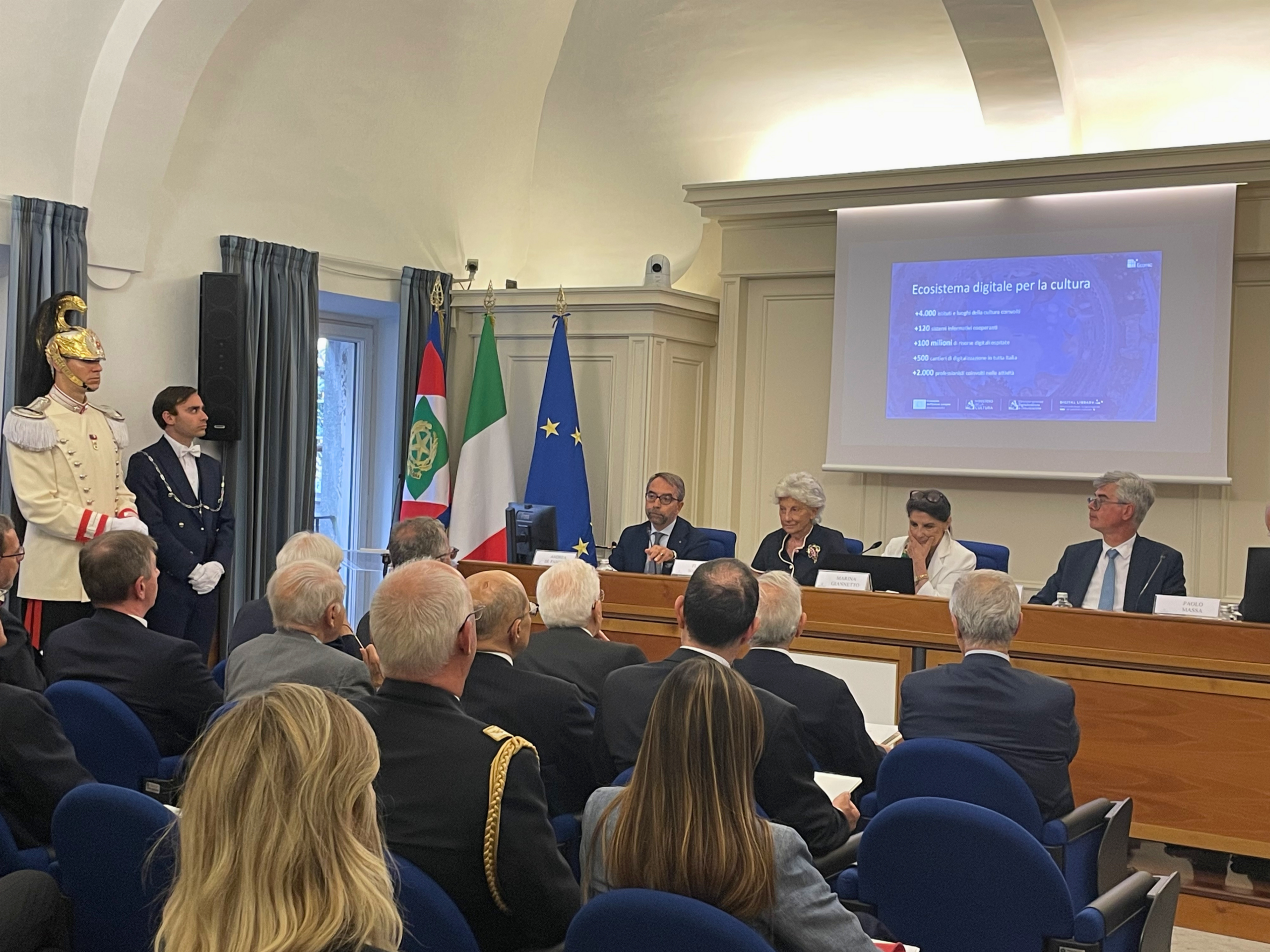
On 2 July 2026, at the Historical Archives of the Presidency of the Republic, the study meeting “Preserving Archives: Understanding to Share the Memory of Networks and the Digital Age Over Time” was held, organized as part of the initiatives marking the eightieth anniversary of the founding of the Republic and the thirtieth anniversary of the Historical Archives.
During the event, in the presence of President of the Republic Sergio Mattarella, the Director-General for Digitalization and Communication of the Ministry of Culture, Andrea De Pasquale, presented the results achieved by the Directorate-General through Ecomic, the Digital Ecosystem for Culture developed by the Central Institute for the Digitization of Cultural Heritage – Digital Library.
The meeting represented a moment of particular institutional significance, during which – within the framework of the digital transition policies pursued by the Historical Archives of the Presidency of the Republic – the main outcomes of the broader digital transformation programme of Italy’s cultural heritage, implemented as part of the National Recovery and Resilience Plan, were presented.
In his speech, De Pasquale highlighted how the digitization of culture had by now become a strategic pillar of public policies, capable of profoundly affecting the ways in which collective memory is safeguarded, studied and enhanced. Archives, libraries, museums and cultural institutions have progressively been integrated into a system of interconnection and interoperability, based on the sharing of digital resources and on the creation of a national knowledge ecosystem.
At the centre of the presentation was Ecomic, the national infrastructure dedicated to the management of digital cultural heritage throughout its entire lifecycle: from production to preservation, from data enrichment to enhancement and reuse. A system designed to overcome the fragmentation of individual institutions and to ensure unified governance of digital heritage.
The data presented highlighted the scale of the project: Ecomic has involved more than 4,000 cultural institutions, brought 120 information systems into cooperation and made approximately 100 million digital resources available.
A decisive role was played by the interventions financed through the NRRP, thanks to which 75 million digital objects were produced through more than 500 digitization projects launched throughout the national territory, as part of an overall investment of 500 million euros.
The programme has also generated a significant employment and professional impact, involving more than 2,000 operators, including technicians, professionals, companies and staff from cultural institutions engaged in digitization processes and in the development of the ecosystem.
In his speech, the Director-General highlighted how these results marked a structural change in the management of Italy’s cultural heritage, which, for the first time, has been organized within a national systemic vision capable of integrating central administrations, Regions, the academic world, scientific communities and cultural enterprises.