
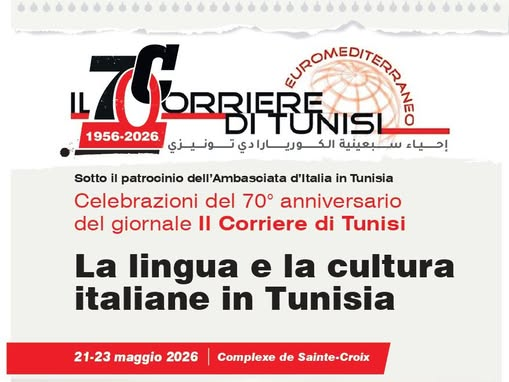
The General Director of Digitalization and Communication, Andrea De Pasquale, participated in the inaugural day of the celebrations for the 70th anniversary of the newspaper “Il Corriere di Tunisi”, from 21 to 23 May in the Santa Croce Complex, in the Medina of Tunis, speaking with a reflection on the richness of the printed production of the Italian community in Tunisia.
The most complete collection of “Il Corriere di Tunisi”, which covers publications from 1958 to 1997, is preserved at the National Central Library of Rome, originating from the IsIAO library, and has been the subject of a digitization project promoted and coordinated by the General Directorate for Digitalization and Communication of the Ministry of Culture, as part of the PNRR M1C3 1.1 investments – “Digital strategies and platforms for cultural heritage”.
A cultural heritage of great value, today preserved, often in a fragmentary manner, between the institutions of the two countries, which testifies to a shared history still partly to be rediscovered.
The digitization of the Corriere di Tunisi represents a unique opportunity to gather this heritage and connect its parts, celebrating the newspaper's history and rediscovering the voices that have remained imprinted within it.
"The digitization of the Italian-speaking newspaper 'Il Corriere di Tunisi' is a fundamental piece in reconstructing the mosaic of the collective history of Italians outside the peninsula, as well as a model for future projects dedicated to the Italian press abroad," the General Director explained. "The project to digitize the newspaper was born with the aim of enhancing the activities of the Italian community and offering a tool for knowledge and support to scholars and institutions. Digitizing these archives means not only preserving the historical memory of the Italian community in Tunisia, but also "reconnecting this heritage to its context, creating connections between newspapers, places, buildings, and other cultural assets."
Furthermore, he also illustrated the national project "Digital Ecosystem for Culture – Ecomic", which already collects over 75 million digital resources – destined to soon become 100 million – relating to archival, library, museum, and archaeological assets. (ANSA)